
Two Miles Daily, Issue 062: What a Month of Clean Books Actually Looks Like
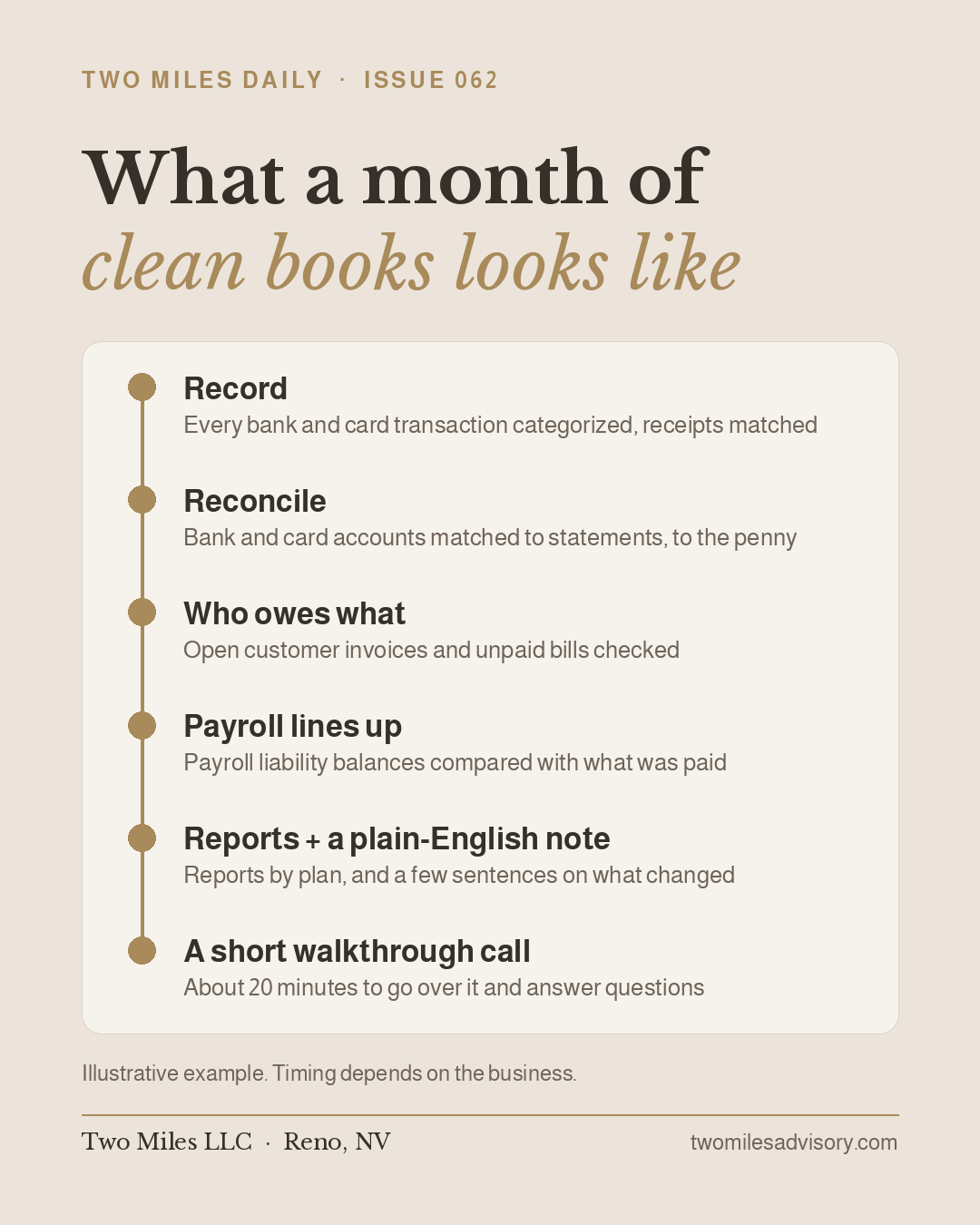
"Clean books" gets said a lot, and I don't think people always know what it means in practice. So here's what a normal month looks like when the books are being kept up. This is an illustrative example, not a promise of exact dates. Timing depends on when statements come in and how big the business is, and what's included depends on the plan.
Hypothetical business: a small HVAC company with a few techs, one bank account, two credit cards and a truck loan.
Right after month-end: everything gets recorded. Every transaction from the bank and credit cards is categorized, and receipts are matched where they're available. Anything I can't figure out goes on a short question list for the owner. It's usually a handful of items, like "What was this $480 online order?" or "Is this deposit for the Johnson job?"
Every account gets reconciled. The bank account and both credit cards are reconciled to their statements, line by line, to the penny. The truck loan balance is matched to the lender's statement. This is the step that makes every report after it more reliable. If the books aren't reconciled, the P&L can be off, and you won't know by how much.
Money owed, both directions. I go through open customer invoices: who owes what, and how long it's been. Same for bills the business owes. A customer more than 60 days past due gets flagged now, not discovered in March.
Payroll and liabilities line up. Payroll entries are recorded, and the payroll liability balances on the books are compared with what the payroll provider says was paid. Payroll tax filing and deposits stay with your payroll provider or CPA.
Reports, plus a note in plain English. Depending on the plan: a profit and loss, a balance sheet and an aging of what customers owe. These are bookkeeping reports prepared from your records. Along with them, a few sentences such as: "Revenue was up, but materials ran high on two installs. Three invoices are more than 60 days past due. Cash covers the next payroll based on the balances today."
A short walkthrough call. About 20 minutes to go over it and answer questions.
That's it. No drama. The value shows up after a few months of this: you stop guessing, you can answer "what are we owed?" in seconds, a lender's request for financials is easier to answer, and at tax time you hand your preparer a file that's already organized.
If you'd like your month-end to look like this, send me a message through the Contact page. Tell me a little about your business, and I'll tell you honestly what it would take to get there.
— Rachel, Two Miles LLC