

ISSUE 034 • Growth Doesn’t Solve Operational Problems
Many business owners believe that increasing sales will solve their biggest challenges. In reality, growth often magnifies operational weaknesses. Before scaling your business, make sure your processes, systems, and financial controls are ready to grow with you.
Executive Brief • July 28, 2026 • Two Miles Advisory
Executive Perspective
One of the biggest misconceptions in business is that growth solves problems.
More sales.
More customers.
More employees.
More revenue.
It sounds like the perfect solution.
But in reality, growth rarely fixes operational problems.
It usually exposes them.
In many cases, it makes them significantly worse.
Revenue Is an Amplifier
Imagine your business as a house with a small leak in the roof.
During a light rain, the damage seems manageable.
Now imagine a major storm.
The roof doesn't suddenly become stronger because there's more rain.
The weakness simply becomes more obvious.
Business works the same way.
When revenue increases, every existing process is put under greater pressure.
If your invoicing process is inefficient today, it will become overwhelming with twice the number of customers.
If your inventory management is inconsistent today, more orders will create even more shortages and errors.
If communication between departments is poor, additional employees often create more confusion rather than greater efficiency.
Growth amplifies what already exists.
Strong Businesses Scale Their Systems First
Successful companies understand that growth should be supported—not chased.
Before adding more customers, they ask questions like:
Can our current systems handle double the workload?
Are our financial reports timely and accurate?
Can we collect customer payments efficiently?
Do employees understand their responsibilities?
Are our processes documented and repeatable?
These questions may not feel exciting.
But they create the foundation for sustainable growth.
Operational Excellence Creates Financial Strength
Every efficient process eventually appears in your financial statements.
Invoices go out faster.
Customers pay sooner.
Errors decrease.
Labor becomes more productive.
Projects finish on schedule.
Profit margins improve.
Cash flow becomes more predictable.
Strong operations create strong financial performance.
The opposite is also true.
Weak operations quietly consume profits through wasted time, unnecessary expenses, customer dissatisfaction, and avoidable mistakes.
Growth Without Control Creates Risk
Many businesses celebrate rapid growth without recognizing the risks that accompany it.
Hiring too quickly.
Accepting projects without adequate planning.
Expanding into new markets without sufficient cash reserves.
Growing revenue while neglecting profitability.
These decisions can create the appearance of success while increasing financial pressure behind the scenes.
Growth should strengthen your business—not strain it.
Build Before You Scale
One of the best investments any business owner can make is improving the systems that support future growth.
Document your processes.
Measure key performance indicators.
Review your financial statements regularly.
Improve communication.
Strengthen internal controls.
These investments rarely make headlines.
But they create businesses that can grow confidently for years to come.
The companies that scale successfully are rarely the ones growing the fastest.
They're the ones with the strongest foundation.
CFO Insight
Growth magnifies both strengths and weaknesses. Build strong systems before you build a bigger business.
About Two Miles Daily
Two Miles Daily is a daily executive briefing from Two Miles Advisory, delivering practical insights on leadership, finance, operations, and business strategy for entrepreneurs and growing businesses.
Our mission is simple:
Help business owners make one better decision every day.
Think Like a CEO. Decide Like a CFO. Build Like an Owner.
Published by Two Miles Advisory

ISSUE 033 • The Cost of Waiting
Every business decision has a cost, including the decision to wait. Delaying a pricing change, difficult conversation, hiring decision, or overdue process improvement may feel safer in the moment, but waiting often allows small problems to become larger and more expensive.
Executive Brief • July 27, 2026 • Two Miles Advisory
Executive Perspective
One of the most expensive decisions in business is the decision to wait.
It rarely feels costly in the moment.
In fact, waiting often feels safe.
"We'll address it next month."
"Let's see how things look after the next quarter."
"We'll revisit it when business slows down."
Unfortunately, problems rarely become smaller simply because we postpone them.
Small Problems Grow Quietly
Most business challenges begin as minor inconveniences.
A customer starts paying a little slower.
Gross margins decline by a few percentage points.
Inventory slowly accumulates.
Operating expenses increase one subscription at a time.
An employee struggles with performance.
None of these issues seem urgent on their own.
But together, they can quietly reshape the financial health of an entire business.
The longer they're ignored, the more expensive they become.
Opportunity Has an Expiration Date
Waiting doesn't just increase costs.
It also delays opportunity.
Perhaps you've considered:
Hiring someone who would free your time.
Investing in software that improves efficiency.
Raising prices to reflect increased costs.
Creating processes that reduce mistakes.
Expanding into a profitable market.
Every month you delay, you're also delaying the benefits those decisions could have generated.
Sometimes the greatest cost isn't what you lose.
It's what you never gain.
Perfect Information Doesn't Exist
Many leaders delay decisions because they want more certainty.
More information.
More confidence.
The reality is that no business owner ever has complete information.
Markets change.
Customers change.
Employees change.
Conditions change.
Successful leaders don't wait for perfect certainty.
They make informed decisions using the best information available, then adjust as they learn more.
Progress almost always beats perfection.
The Financial Cost of Delay
As a financial controller, I've seen businesses spend months discussing problems that could have been solved in a single afternoon.
An overdue customer becomes an uncollectible account.
An outdated pricing model quietly reduces profitability.
A hiring decision delayed too long causes burnout for the entire team.
Every delay has a financial impact.
Sometimes it's visible.
Often it isn't.
Build a Habit of Decisive Leadership
This doesn't mean making reckless decisions.
It means developing a habit of addressing important issues while they're still manageable.
Ask yourself:
What decision have I been postponing?
Why am I waiting?
What is waiting actually costing me?
You may discover that taking action today is far less expensive than delaying another month.
Business rewards thoughtful action—not endless hesitation.
CFO Insight
The cost of waiting is often greater than the cost of deciding. Progress begins when action replaces hesitation.
About Two Miles Daily
Two Miles Daily is a daily executive briefing from Two Miles Advisory, delivering practical insights on leadership, finance, operations, and business strategy for entrepreneurs and growing businesses.
Our mission is simple:
Help business owners make one better decision every day.
Think Like a CEO. Decide Like a CFO. Build Like an Owner.
Published by Two Miles Advisory

ISSUE 032 • Your Financial Statements Are Trying to Tell You Something
Your financial statements reveal more than whether your business made money. They show what is working, where risks are growing, and which decisions deserve your attention next.
Executive Brief • July 26, 2026 • Two Miles Advisory
Executive Perspective
When most business owners receive their monthly financial statements, one of two things happens.
Some glance at the bottom line to see if they made money, then file the reports away until next month.
Others never look at them at all, relying instead on their bank account balance to tell them whether the business is doing well.
Unfortunately, neither approach provides the insight needed to lead a successful company.
Your financial statements are not simply reports for your accountant, your lender, or the IRS. They are management tools. Every month, they provide valuable information about where your business has been, where it stands today, and where it may be headed if nothing changes.
The Profit & Loss Statement
The Profit & Loss Statement (Income Statement) answers one important question:
"Did the business make money during this period?"
But the real value isn't found in the bottom line.
It comes from understanding why profits increased or decreased.
Did revenue grow because you gained more customers—or because existing customers spent more?
Did gross margins improve because pricing increased, or because purchasing became more efficient?
Did operating expenses rise because you invested in growth, or because unnecessary costs slowly accumulated?
A good controller or CFO doesn't simply report profit. They explain the story behind it.
The Balance Sheet
Many business owners rarely review their Balance Sheet, yet it may be the most overlooked financial statement in business.
Your Balance Sheet tells you whether your company is becoming stronger over time.
It answers questions such as:
Are cash reserves growing?
Are customers paying on time?
Is inventory increasing faster than sales?
Is debt becoming difficult to manage?
Is owner equity growing year after year?
While the Profit & Loss Statement measures performance over time, the Balance Sheet provides a snapshot of your company's financial health on a specific date.
The Cash Flow Statement
A profitable company can still fail.
In fact, many businesses close their doors despite showing profits on paper.
Why?
Because profit and cash are not the same thing.
The Cash Flow Statement explains where cash is coming from and where it is going.
It helps answer questions like:
Why is the bank account lower even though profits were positive?
Are customers taking too long to pay?
Is inventory tying up too much cash?
Are loan payments consuming available cash flow?
Is the business generating enough cash to support future growth?
Understanding cash flow is often the difference between reacting to financial problems and preventing them.
Financial Statements Should Drive Decisions
Numbers by themselves are just numbers.
Their value comes from asking better questions.
Instead of simply reviewing whether revenue increased, ask why.
Instead of focusing only on expenses, identify which costs create the greatest return.
Instead of looking at profit alone, evaluate cash flow, customer trends, margins, and long-term financial health together.
Successful businesses don't make decisions based on assumptions.
They make decisions based on reliable information.
Start Small
You don't need to become an accountant to gain value from your financial statements.
Start by reviewing them every month.
Compare this month's results to last month.
Compare them to the same month last year.
Identify one positive trend and one area that deserves attention.
Over time, you'll begin to recognize patterns long before they become problems.
The businesses that consistently outperform their competitors aren't always the biggest.
They're often the ones that understand their numbers—and use them to make better decisions.
CFO Insight
Your financial statements don't just report the past—they help shape the future. Learn to read the story behind the numbers, and you'll make better decisions for your business.
About Two Miles Daily
Two Miles Daily is a daily executive briefing from Two Miles Advisory, delivering practical insights on leadership, finance, operations, and business strategy for entrepreneurs and growing businesses.
Our mission is simple:
Help business owners make one better decision every day.
Think Like a CEO. Decide Like a CFO. Build Like an Owner.
Published by Two Miles Advisory

ISSUE 031 • The Best Time to Fix a Problem Is Before You Have One
Preparation is one of the most overlooked competitive advantages in business. Discover why proactive leaders spend more time preventing problems than reacting to them.
Executive Brief • July 25, 2026 • Two Miles Advisory
Executive Perspective
Successful businesses don't wait for problems.
They prepare for them.
They don't buy insurance after the accident.
They don't create a cash reserve after the downturn.
They don't document critical processes after a key employee leaves.
The strongest businesses spend more time preparing than reacting.
That preparation rarely feels urgent.
Until the day it becomes essential.
Business owners often ask:
"What should I focus on next?"
Here's a better question.
"What could hurt this business if it happened tomorrow?"
Would you lose a major customer?
Could you survive three months of slower sales?
Does someone else know how to perform critical tasks?
Would your financial information help you make quick decisions?
Preparation isn't pessimism.
It's leadership.
Great leaders don't assume everything will go wrong.
They simply understand that uncertainty is part of running a business.
The businesses that recover the fastest are usually the ones that planned before they needed to.
Boardroom Question
If your biggest customer disappeared tomorrow...
Would your business survive?
If your operations manager resigned?
If your bank required updated financials?
If sales slowed for one quarter?
Which risks deserve your attention today—not because they're likely, but because they're possible?
One Better Decision
Choose one area of your business that depends too heavily on a single person, customer, vendor, or process.
Then ask:
"How can we reduce this risk over the next 90 days?"
Preparation doesn't eliminate uncertainty.
It reduces its impact.
CFO Insight
Strong businesses prepare before they're forced to.
About Two Miles Daily
Two Miles Daily is a daily executive briefing from Two Miles Advisory, delivering practical insights on leadership, finance, operations, and business strategy for entrepreneurs and growing businesses.
Our mission is simple:
Help business owners make one better decision every day.
Think Like a CEO. Decide Like a CFO. Build Like an Owner.
Published by Two Miles Advisory

ISSUE 030 • Your Business Is Always Selling
Sales doesn't begin with a proposal. It begins with every interaction a customer has with your business. Discover how trust is built long before a contract is signed.
Executive Brief • July 24, 2026 • Two Miles Advisory
Executive Perspective
Most business owners believe selling begins when they present a proposal.
It doesn't.
Selling begins long before a customer asks for a quote.
It begins with the first phone call.
The speed of your response.
The professionalism of your website.
The clarity of your communication.
The way your employees answer questions.
The condition of your office.
The accuracy of your invoices.
The consistency of your follow-up.
Every interaction either builds confidence...
Or quietly erodes it.
Customers aren't just evaluating your product.
They're evaluating whether they trust your business.
That's why great businesses understand something important.
Sales isn't a department.
It's an experience.
Marketing creates awareness.
Sales creates opportunity.
Operations fulfills the promise.
Accounting reinforces professionalism.
Customer service builds loyalty.
Leadership shapes the culture that customers ultimately experience.
Every part of your business is selling something.
The only question is...
What is it selling?
Boardroom Question
What impression does your business create before a customer ever signs a contract?
Would they describe your business as:
Professional?
Responsive?
Reliable?
Organized?
Easy to work with?
Or would they hesitate?
The smallest interactions often create the strongest impressions.
One Better Decision
Choose one point in your customer's journey.
Call your office.
Complete your online contact form.
Request a quote.
Pay an invoice.
Read your proposal.
Experience your business exactly as a customer would.
Then ask yourself:
Would I confidently buy from this company?
CFO Insight
Every interaction either builds trust—or weakens it.
About Two Miles Daily
Two Miles Daily is a daily executive briefing from Two Miles Advisory, delivering practical insights on leadership, finance, operations, and business strategy for entrepreneurs and growing businesses.
Our mission is simple:
Help business owners make one better decision every day.
Think Like a CEO. Decide Like a CFO. Build Like an Owner.
Published by Two Miles Advisory

ISSUE 029 • Your Financial Statements Are Trying to Tell You Something
Your financial statements are more than reports—they're decision-making tools. Learn how successful business owners use them to identify risks, opportunities, and trends.
Executive Brief • July 23, 2026 • Two Miles Advisory
Executive Perspective
Most business owners look at their financial statements for one reason.
To see whether they made money.
That's important.
But it's only the beginning.
Your financial statements tell a much bigger story.
Your income statement reveals how efficiently you're generating profit.
Your balance sheet shows the financial strength of your business.
Your cash flow statement explains why profitable businesses can still struggle to pay their bills.
Together, these reports answer questions every business owner should ask.
Are margins improving?
Are customers paying more slowly?
Is debt increasing?
Is inventory growing faster than sales?
Are operating expenses beginning to outpace revenue?
Financial statements don't just record history.
They highlight trends.
And trends help leaders make better decisions before small issues become major problems.
The strongest business owners don't review financial statements because their accountant tells them to.
They review them because they understand that every number tells part of the story.
The goal isn't simply to know your numbers.
The goal is to understand what they're trying to tell you.
Boardroom Question
If I removed the profit number from your financial statements...
Could you still tell whether your business is becoming healthier?
What trends would you notice?
What concerns would you identify?
What opportunities would you see?
Great leaders read beyond the bottom line.
One Better Decision
This month, review your financial statements with one question in mind:
"What changed?"
Don't stop at the numbers.
Ask why.
Why did gross margin change?
Why did operating expenses increase?
Why did accounts receivable grow?
Why did cash decline?
The questions are often more valuable than the answers.
CFO Insight
Financial statements don't make decisions. They improve the quality of the decisions you make.
About Two Miles Daily
Two Miles Daily is a daily executive briefing from Two Miles Advisory, delivering practical insights on leadership, finance, operations, and business strategy for entrepreneurs and growing businesses.
Our mission is simple:
Help business owners make one better decision every day.
Think Like a CEO. Decide Like a CFO. Build Like an Owner.
Published by Two Miles Advisory

ISSUE 028 • Every Dollar Should Have a Job
Every dollar in your business should support a purpose. Discover how intentional capital allocation leads to smarter decisions and sustainable growth.
Executive Brief • July 22, 2026 • Two Miles Advisory
Executive Perspective
Money sitting in your business isn't just cash.
It's opportunity.
Every dollar your business earns has a purpose.
It can strengthen your balance sheet.
Fund future growth.
Reduce debt.
Improve operations.
Reward employees.
Invest in technology.
Or provide a return to the owner.
The question isn't whether your business is making money.
The question is:
What is that money doing?
Successful businesses don't allow cash to accumulate without intention.
They make deliberate decisions about capital.
Every investment should answer one simple question:
How does this make the business stronger?
Sometimes the answer is purchasing new equipment.
Sometimes it's hiring a key employee.
Sometimes it's keeping additional cash in reserve.
Sometimes it's choosing not to spend at all.
Cash isn't valuable because you have it.
Cash is valuable because it gives you options.
Great leaders understand that every dollar should support the long-term health of the business.
Money without a purpose rarely creates lasting value.
Boardroom Question
If I reviewed every dollar your business spent over the last 90 days...
Would I understand your strategy?
Would your spending reflect:
Growth?
Efficiency?
Leadership?
Customer experience?
Or would it reveal decisions made without a clear purpose?
One Better Decision
Review one significant expense from the past three months.
Ask yourself:
Did this investment produce measurable value?
Would we make the same decision again?
If we hadn't spent this money, what would have changed?
Every dollar should earn its place in your business.
CFO Insight
Money is a resource. Strategy determines its value.
About Two Miles Daily
Two Miles Daily is a daily executive briefing from Two Miles Advisory, delivering practical insights on leadership, finance, operations, and business strategy for entrepreneurs and growing businesses.
Our mission is simple:
Help business owners make one better decision every day.
Think Like a CEO. Decide Like a CFO. Build Like an Owner.
Published by Two Miles Advisory

ISSUE 027 • Your Budget Isn't Meant to Be Right
Budgets aren't valuable because they're perfect. They're valuable because they help business owners understand what changed, why it changed, and what to do next.
Executive Brief • July 21, 2026 • Two Miles Advisory
Executive Perspective
One of the biggest misconceptions in business is that a budget is supposed to predict the future perfectly.
It isn't.
A budget is a decision-making tool.
Markets change.
Customers delay projects.
Material costs fluctuate.
Employees leave.
Unexpected opportunities appear.
No budget survives an entire year exactly as planned.
And that's okay.
The value of a budget isn't found in whether every number is accurate.
The value is found in comparing what you expected to happen with what actually happened.
Those differences tell a story.
Why did labor costs increase?
Why did revenue exceed expectations?
Why are expenses trending higher?
What changed?
Without a budget, it's difficult to answer those questions.
You aren't just managing the business.
You're reacting to it.
The best business owners don't treat budgets as predictions.
They treat them as roadmaps.
When the road changes, they adjust the route.
But they never stop using the map.
Boardroom Question
If your actual results differ from your budget every month...
Do you see that as failure?
Or valuable information?
Because every variance is trying to teach you something.
One Better Decision
Choose one line on your Profit & Loss statement.
Compare:
Budget
Actual
Difference
Don't stop there.
Ask why.
Then decide whether your budget—or your business—needs to change.
Budgets don't improve businesses.
The conversations they create do.
CFO Insight
A budget isn't about being right. It's about making better decisions.
About Two Miles Daily
Two Miles Daily is a daily executive briefing from Two Miles Advisory, delivering practical insights on leadership, finance, operations, and business strategy for entrepreneurs and growing businesses.
Our mission is simple:
Help business owners make one better decision every day.
Think Like a CEO. Decide Like a CFO. Build Like an Owner.
Published by Two Miles Advisory

ISSUE 026 • Your Business Doesn't Have a Sales Problem
Before chasing more customers, ask whether you're maximizing the value of the ones you already have. Sustainable growth often comes from improving your existing business—not simply adding more sales.
Executive Brief • July 20, 2026 • Two Miles Advisory
Executive Perspective
When sales slow down, the first instinct is usually the same.
"We need more customers."
Sometimes that's true.
But often...
The real problem isn't sales.
It's conversion.
Or pricing.
Or customer retention.
Or delayed invoicing.
Or shrinking margins.
Or poor follow-up.
Or inconsistent service.
Many businesses spend thousands of dollars generating new leads while quietly losing profit through problems they already control.
Before investing more in marketing, ask yourself:
Are we maximizing the opportunities we already have?
Could we improve our response time?
Could we improve our proposal process?
Could we increase repeat business?
Could we shorten our collections cycle?
Could we improve customer experience?
Growth isn't always about adding more.
Sometimes it's about improving what already exists.
The strongest businesses don't immediately chase new revenue.
They first strengthen the systems that produce it.
Boardroom Question
If you doubled your leads tomorrow...
Could your business consistently deliver an exceptional customer experience?
If not...
The bottleneck isn't sales.
It's capacity.
It's process.
It's execution.
One Better Decision
Before increasing your marketing budget this quarter, review these five numbers:
Lead-to-customer conversion rate
Average project margin
Customer retention rate
Average days to invoice
Accounts receivable over 30 days
Improving one of these metrics may generate more profit than finding another customer.
CFO Insight
The fastest way to grow isn't always finding more customers. It's serving the right customers better.
About Two Miles Daily
Two Miles Daily is a daily executive briefing from Two Miles Advisory, delivering practical insights on leadership, finance, operations, and business strategy for entrepreneurs and growing businesses.
Our mission is simple:
Help business owners make one better decision every day.
Think Like a CEO. Decide Like a CFO. Build Like an Owner.
Published by Two Miles Advisory

ISSUE 025 • Customers Rarely Buy the Cheapest Option
Customers rarely buy based on price alone. Discover why trust is one of the most valuable competitive advantages your business can build.
Executive Brief • July 19, 2026 • Two Miles Advisory
Executive Perspective
One of the biggest misconceptions in business is that customers always choose the lowest price.
Sometimes they do.
But more often...
They choose the option they trust the most.
Think about the last major purchase you made.
Did you choose the absolute cheapest contractor?
The least expensive attorney?
The lowest-cost CPA?
Probably not.
You looked for experience.
Responsiveness.
Professionalism.
Confidence.
You wanted someone who would reduce risk—not create more of it.
The same is true for your customers.
Businesses that compete only on price eventually find themselves in a race to the bottom.
Margins shrink.
Service suffers.
Growth slows.
The strongest companies compete differently.
They earn trust before asking for the sale.
They communicate clearly.
They deliver consistently.
They solve problems.
They become known for reliability.
When customers believe you're the safest choice...
Price becomes only one part of the decision.
Not the entire decision.
Boardroom Question
If your prices increased by 10% tomorrow...
What additional value would customers expect to receive?
Would they notice better communication?
Faster response times?
Greater expertise?
More confidence?
Or would the experience remain exactly the same?
One Better Decision
This week, ask one of your best customers:
"Why did you choose us instead of someone else?"
Don't assume you know the answer.
You may discover your greatest competitive advantage isn't your pricing.
It's your reputation.
Build on that.
CFO Insight
Trust creates pricing power.
About Two Miles Daily
Two Miles Daily is a daily executive briefing from Two Miles Advisory, delivering practical insights on leadership, finance, operations, and business strategy for entrepreneurs and growing businesses.
Our mission is simple:
Help business owners make one better decision every day.
Think Like a CEO. Decide Like a CFO. Build Like an Owner.
Published by Two Miles Advisory

ISSUE 024 • The Tyranny of Urgency
Urgent work never disappears—but great leaders spend less time reacting and more time preventing. Discover how better systems reduce chaos and improve business performance.
Executive Brief • July 18, 2026 • Two Miles Advisory
Executive Perspective
Every business has urgent work.
An unexpected customer call.
An equipment failure.
A payroll issue.
A vendor problem.
A last-minute request.
Urgency isn't the enemy.
Living in urgency is.
Too many leaders spend every day putting out fires.
They become excellent firefighters.
But they never become architects.
Architecture requires time.
It requires thought.
It requires planning.
The strongest businesses don't eliminate urgent problems.
They reduce how often those problems occur.
They improve systems.
They train people.
They establish expectations.
They invest in prevention instead of constantly reacting.
Over time, something remarkable happens.
The business becomes calmer.
Not because there's less work.
Because there's less chaos.
Leadership isn't measured by how many emergencies you solve.
It's measured by how few emergencies your business creates.
Boardroom Question
If you disappeared for one week...
What emergencies would still happen?
Now ask yourself...
Which of those could have been prevented with a better process?
A clearer expectation?
Better training?
A stronger system?
Today's emergency is often yesterday's neglected process.
One Better Decision
This week, write down every interruption you experience.
At the end of the week, review the list.
For each interruption, ask:
Was this predictable?
Was it preventable?
What system would reduce the chance of it happening again?
Don't just solve problems.
Build a business that creates fewer of them.
CFO Insight
Great leaders spend less time reacting because they've spent more time preparing.
About Two Miles Daily
Two Miles Daily is a daily executive briefing from Two Miles Advisory, delivering practical insights on leadership, finance, operations, and business strategy for entrepreneurs and growing businesses.
Our mission is simple:
Help business owners make one better decision every day.
Think Like a CEO. Decide Like a CFO. Build Like an Owner.
Published by Two Miles Advisory
ISSUE 023 • The Cost of Waiting
The cost of waiting rarely appears on a financial statement—but it affects every business. Discover why decisive leaders build stronger companies.
Executive Brief • July 17, 2026 • Two Miles Advisory
Executive Perspective
Every business owner has delayed a decision.
Waiting for more information.
Waiting for the market.
Waiting until next quarter.
Waiting until things "settle down."
Sometimes waiting is wise.
Often...
It's expensive.
Every delayed hire places additional pressure on your team.
Every postponed pricing adjustment erodes margin.
Every unresolved customer issue weakens trust.
Every outdated process quietly consumes time.
Indecision has a cost.
It rarely appears on the financial statements.
But it shows up in slower growth.
Higher stress.
Missed opportunities.
And exhausted leaders.
Great business owners don't make reckless decisions.
They make informed decisions.
Then they move.
Because progress almost always comes from action—not perfection.
Waiting doesn't eliminate risk.
Sometimes...
It becomes the biggest risk of all.
Boardroom Question
What important decision have you been postponing?
What is it costing you every week you delay it?
Lost revenue?
Lost time?
Lost momentum?
Lost confidence?
Sometimes the price of waiting is far greater than the price of acting.
One Better Decision
Write down one business decision you've avoided.
Ask yourself three questions.
What facts do I already know?
What information am I still waiting for?
Will that information truly change my decision?
If not...
Decide.
Momentum often begins with one courageous decision.
CFO Insight
Delayed decisions often become expensive decisions.
About Two Miles Daily
Two Miles Daily is a daily executive briefing from Two Miles Advisory, delivering practical insights on leadership, finance, operations, and business strategy for entrepreneurs and growing businesses.
Our mission is simple:
Help business owners make one better decision every day.
Think Like a CEO. Decide Like a CFO. Build Like an Owner.
Published by Two Miles Advisory

ISSUE 022 • Busy Doesn't Mean Productive
Busy businesses often mistake activity for progress. Learn how successful leaders focus on work that creates measurable value instead of simply staying busy.
Executive Brief • July 16, 2026 • Two Miles Advisory
Executive Perspective
Walk through almost any business and you'll hear the same thing.
"We've been busy."
Phones are ringing.
Emails are flying.
Meetings fill the calendar.
Projects are moving.
People are working hard.
But activity and productivity are not the same thing.
A business can be incredibly busy while becoming less profitable.
Busy teams often spend their time reacting.
Productive teams spend their time improving.
They automate repetitive work.
They eliminate unnecessary approvals.
They simplify communication.
They reduce rework.
They focus on outcomes—not just effort.
The goal of leadership isn't to create more activity.
It's to create more value.
Being busy may feel productive.
But productive businesses create measurable results.
Before celebrating how busy your team has become...
Ask whether all that activity is actually moving the business forward.
Boardroom Question
If your team worked 20% fewer hours next month...
What work would you stop doing?
Would the business actually suffer?
Or would it simply become more focused?
Sometimes eliminating unnecessary work creates more value than adding new work.
One Better Decision
This week, identify one recurring task that:
Doesn't create value.
Could be automated.
Could be delegated.
Could be eliminated entirely.
Ask one simple question:
"If we stopped doing this tomorrow, would anyone notice?"
If the answer is no...
Stop doing it.
Productivity isn't doing more.
It's doing what matters most.
CFO Insight
Activity creates motion. Productivity creates progress.
About Two Miles Daily
Two Miles Daily is a daily executive briefing from Two Miles Advisory, delivering practical insights on leadership, finance, operations, and business strategy for entrepreneurs and growing businesses.
Our mission is simple:
Help business owners make one better decision every day.
Think Like a CEO. Decide Like a CFO. Build Like an Owner.
Published by Two Miles Advisory

Issue No. 021 | The Most Expensive Words in Business: "We'll Figure It Out Later."
The most expensive phrase in business isn't "we made a mistake."
It's "we'll figure it out later."
Every recurring problem is an opportunity to build a better process. Strong businesses don't run on hustle—they run on systems.
Executive Brief • July 15, 2026 • Two Miles Advisory
Executive Perspective
Most businesses don't fail because of one catastrophic decision.
They fail because of hundreds of small decisions made without a process.
"We'll figure out payroll later."
"We'll clean up the books after year-end."
"We'll deal with that contract next month."
"We'll organize our files when things slow down."
The problem is that things rarely slow down.
Every shortcut today becomes tomorrow's bottleneck. Every delayed decision compounds into more work, more stress, and more risk.
Strong businesses aren't built by reacting quickly.
They're built by creating systems that prevent problems from happening in the first place.
Boardroom Question
What is one recurring problem in your business that shouldn't still exist?
If it keeps happening, the issue probably isn't your people.
It's your process.
One Better Decision
This week, identify one task your team repeats over and over.
Then ask:
Can it be documented?
Can it be automated?
Can it be eliminated?
Every documented process creates more capacity for growth.
CFO Insight
Chaos is expensive.
Businesses often focus on cutting costs while ignoring the hidden costs of:
Poor documentation
Inconsistent workflows
Rework
Missed deadlines
Errors caused by unclear ownership
The most profitable companies aren't always the busiest.
They're usually the most organized.
About Two Miles Daily
Two Miles Daily is a daily executive briefing from Two Miles Advisory, delivering practical insights on leadership, finance, operations, and business strategy for entrepreneurs and growing businesses.
Our mission is simple:
Help business owners make one better decision every day.
Think Like a CEO. Decide Like a CFO. Build Like an Owner.
Published by Two Miles Advisory
ISSUE 020 • The Leader You're Becoming
On my 39th birthday, I reflected on one lesson that has shaped my career: businesses rarely outgrow their leaders. The greatest investment isn't just in your company—it's in yourself.
Executive Brief • July 14, 2026 • Two Miles Advisory
Executive Perspective
Today I turn 39.
Birthdays have a way of making you pause.
Not because of the number.
But because they invite reflection.
When I started my career, I believed success was measured by titles.
Then by income.
Then by business growth.
Today, I see success differently.
Success isn't built through one extraordinary decision.
It's built through thousands of ordinary ones.
Keeping your word.
Making the difficult phone call.
Reviewing the financials even when they're uncomfortable.
Learning from mistakes instead of defending them.
Choosing discipline over convenience.
Leading with integrity when no one is watching.
Over time, I've realized something that has changed the way I think about business.
Companies don't become exceptional because they have better ideas.
They become exceptional because they have leaders who continue growing long after everyone else becomes comfortable.
The greatest investment I've ever made wasn't in software.
Or equipment.
Or the stock market.
It was investing in becoming a better leader.
Reading.
Listening.
Learning.
Asking better questions.
Changing my mind when the facts changed.
Every lesson compounded.
Every difficult experience became tuition.
Every mistake became an investment in better judgment.
At 39, I certainly don't have all the answers.
But I know this:
The business you're building will never consistently outperform the person leading it.
When you become a better leader...
Your business follows.
Boardroom Question
One year from today...
Who do you want to become?
Not what do you want to own.
Not how much do you want to earn.
Who do you want to become as a leader?
Because your business will eventually reflect that answer.
One Better Decision
Instead of setting another revenue goal this year...
Set one leadership goal.
Become a better communicator.
A better listener.
A better decision maker.
A better mentor.
Read twelve books.
Ask more questions.
Spend one hour every week intentionally developing yourself.
Because the highest-return investment you'll ever make isn't in your business.
It's in the person leading it.
CFO Insight
Your business grows in direct proportion to your growth as a leader.
About Two Miles Daily
Two Miles Daily is a daily executive briefing from Two Miles Advisory, delivering practical insights on leadership, finance, operations, and business strategy for entrepreneurs and growing businesses.
Our mission is simple:
Help business owners make one better decision every day.
Think Like a CEO. Decide Like a CFO. Build Like an Owner.
Published by Two Miles Advisory
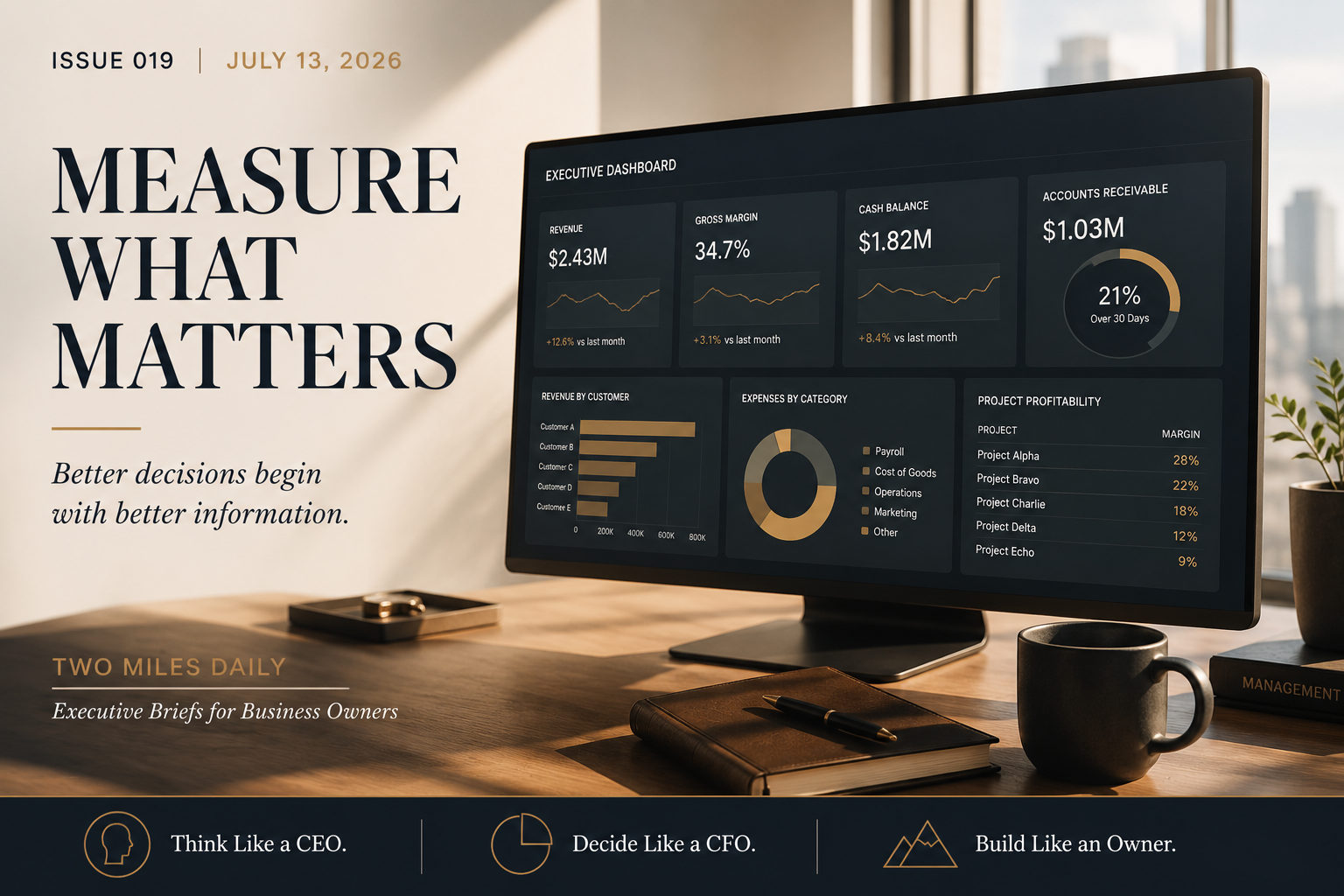
ISSUE 019 • Measure What Matters
The best leaders don't track everything. They measure the few numbers that reveal the true health of their business and use them to make better decisions.
Executive Brief • July 13, 2026 • Two Miles Advisory
Executive Perspective
Every business generates data.
Sales reports.
Bank balances.
Customer lists.
Payroll.
Inventory.
Marketing metrics.
Dashboards.
The challenge isn't finding information.
The challenge is knowing which information deserves your attention.
Too many business owners become overwhelmed by numbers that don't drive better decisions.
They measure activity instead of performance.
They celebrate revenue without reviewing margins.
They monitor website traffic without tracking conversions.
They watch their bank balance without forecasting cash flow.
Successful leaders understand that not every metric deserves equal attention.
They identify a handful of key indicators that reveal the health of the business.
They review them consistently.
They discuss them openly.
And most importantly...
They act on them.
Measurement isn't about creating reports.
It's about creating clarity.
The right numbers won't eliminate uncertainty.
But they will reduce it.
Better information leads to better conversations.
Better conversations lead to better decisions.
And better decisions build stronger businesses.
Boardroom Question
If your leadership team could only review five numbers every Monday morning...
Which five would tell you whether your business is truly healthy?
Would you choose revenue?
Cash flow?
Gross margin?
Accounts receivable?
Customer retention?
Project profitability?
Your answer reveals what your business values.
One Better Decision
Create a one-page executive dashboard.
Not twenty reports.
Not one hundred KPIs.
Just the numbers that matter most.
Review them every week.
Ask:
What improved?
What declined?
Why?
What decision should we make because of this information?
Remember...
A dashboard isn't valuable because it contains numbers.
It's valuable because it changes decisions.
CFO Insight
Measure less. Understand more.
About Two Miles Daily
Two Miles Daily is a daily executive briefing from Two Miles Advisory, delivering practical insights on leadership, finance, operations, and business strategy for entrepreneurs and growing businesses.
Our mission is simple:
Help business owners make one better decision every day.
Think Like a CEO. Decide Like a CFO. Build Like an Owner.
Published by Two Miles Advisory
ISSUE 018 • Every System Produces Exactly What It Was Designed to Produce
When the same problem happens repeatedly, it's time to examine the system—not just the employee. Strong businesses build processes that consistently produce great results.
Executive Brief • July 12, 2026 • Two Miles Advisory
Executive Perspective
Business owners often blame people when results fall short.
An employee missed a deadline.
A shipment went out late.
A customer received the wrong invoice.
A project exceeded budget.
While individual mistakes happen, recurring problems usually point to something deeper.
The system is producing exactly what it was designed to produce.
If invoices are consistently late, examine the billing process.
If inventory is routinely inaccurate, evaluate the inventory controls.
If projects regularly exceed budget, review estimating, approvals, and change order procedures.
Strong businesses don't rely on exceptional people to overcome weak systems.
They build systems that make the right outcome the easiest outcome.
When a problem repeats itself, resist the temptation to ask:
"Who made the mistake?"
Instead ask:
"What allowed this mistake to happen more than once?"
The answer often leads to a better process—not just a better conversation.
Businesses don't improve by fixing people.
They improve by improving systems.
Boardroom Question
What is one problem in your business that keeps happening?
If it has happened more than once...
Is it really a people problem?
Or is it a system problem?
One Better Decision
Choose one recurring issue in your business.
Instead of reminding people to "be more careful,"
map the process.
Ask:
Where does the process begin?
Where does it break down?
Is ownership clear?
Is there a checklist?
Is there a review before completion?
Fix the process first.
Then evaluate performance.
CFO Insight
Systems determine consistency. People execute them.
About Two Miles Daily
Two Miles Daily is a daily executive briefing from Two Miles Advisory, delivering practical insights on leadership, finance, operations, and business strategy for entrepreneurs and growing businesses.
Our mission is simple:
Help business owners make one better decision every day.
Think Like a CEO. Decide Like a CFO. Build Like an Owner.
Published by Two Miles Advisory

Issue 017 • Your Business Shouldn't Depend on You
Your priorities aren't revealed by what you say—they're revealed by where you invest your time. Learn how successful leaders use their calendars as strategic tools.
Executive Brief • July 11, 2026 • Two Miles Advisory
Executive Perspective
Many businesses don't have an operations problem.
They have an owner dependency problem.
The owner approves every purchase.
Answers every question.
Makes every important decision.
Solves every customer issue.
Signs every check.
Eventually, the business reaches a ceiling.
Growth slows.
Employees stop making decisions.
Customers expect immediate access to the owner.
The business becomes successful enough to create stress—but not freedom.
Ironically, many entrepreneurs started a business to gain more freedom.
Instead, they built a business that cannot function without them.
The strongest businesses are built differently.
They establish clear processes.
They document expectations.
They empower capable people to make decisions.
They build systems that produce consistent results.
A great business isn't one where the owner does everything.
It's one where the owner has built an organization that continues to perform—even when they're not in the room.
That's not losing control.
That's creating value.
Boardroom Question
If you were unavailable for the next 30 days...
Would your business continue to operate successfully?
Would invoices still be sent?
Would customers still receive excellent service?
Would employees know what to do?
Would cash continue to flow?
If the answer is "no," you've identified your greatest opportunity for improvement.
One Better Decision
Choose one responsibility that only you currently perform.
Document the process.
Train someone else.
Allow them to perform it with oversight.
Then gradually reduce your involvement.
A business becomes more valuable every time it becomes less dependent on its owner.
CFO Insight
The value of your business increases as its dependence on you decreases.
About Two Miles Daily
Two Miles Daily is a daily executive briefing from Two Miles Advisory, delivering practical insights on leadership, finance, operations, and business strategy for entrepreneurs and growing businesses.
Our mission is simple:
Help business owners make one better decision every day.
Think Like a CEO. Decide Like a CFO. Build Like an Owner.
Published by Two Miles Advisory

ISSUE 016 • Boardroom Friday Should You Say Yes?
If your business can't operate without you, you've built a job—not a scalable business. Learn how successful leaders create systems that outlast them.
Executive Brief • July 10, 2026 • Two Miles Advisory
Executive Perspective
Imagine this.
It's Thursday afternoon.
A potential customer calls with a large opportunity.
The project would increase your revenue by nearly 20%.
There's just one problem.
Your team is already operating at full capacity.
Taking the work means asking employees to work overtime.
It means delaying other customer projects.
It means increasing pressure on cash flow while waiting to get paid.
Turning it down feels impossible.
Accepting it feels risky.
This is the kind of decision business owners face every day.
Growth is exciting.
But sustainable growth requires discipline.
Not every opportunity should become a commitment.
Sometimes the best business decision isn't asking,
"Can we do it?"
It's asking,
"Can we do it well?"
The strongest companies don't build their reputation by saying yes to everything.
They build it by consistently delivering exceptional results.
Boardroom Question
You have two choices.
Option A
Accept the project.
Increase revenue immediately.
Risk overloading your team.
Option B
Decline—or delay—the opportunity.
Protect quality.
Maintain customer service.
Preserve team capacity.
What would you choose—and why?
One Better Decision
Before accepting your next major opportunity, ask three questions:
Do we have the people?
Do we have the systems?
Do we have the cash?
If the answer to any of those is "no," your first investment should be strengthening the business—not increasing the workload.
CFO Insight
The right opportunity at the wrong time is still the wrong decision.
About Two Miles Daily
Two Miles Daily is a daily executive briefing from Two Miles Advisory, delivering practical insights on leadership, finance, operations, and business strategy for entrepreneurs and growing businesses.
Our mission is simple:
Help business owners make one better decision every day.
Think Like a CEO. Decide Like a CFO. Build Like an Owner.
Published by Two Miles Advisory
ISSUE 015 • Your Calendar Reveals Your Strategy
Every opportunity comes with a cost. Learn how successful business owners evaluate growth opportunities before saying yes.
Executive Brief • July 9, 2026 • Two Miles Advisory
Executive Perspective
Every business owner has priorities.
But priorities aren't revealed by what you say.
They're revealed by your calendar.
Take a look at the past two weeks.
How much time did you spend growing the business?
How much time did you spend solving avoidable problems?
Most business owners believe they don't have time for strategy.
The reality is they haven't protected time for it.
Meetings fill the schedule.
Emails demand attention.
Unexpected problems become the day's priority.
Before long, the urgent replaces the important.
Successful leaders understand that every hour on their calendar is an investment.
They intentionally schedule time to review financial performance, strengthen operations, develop their team, and think about the future.
They don't wait until they "have time."
They make time.
Your calendar is more than a schedule.
It's a reflection of your leadership.
Boardroom Question
If someone reviewed your calendar from the last 30 days...
Would they know what your business priorities actually are?
Not from what you said.
From where you invested your time.
One Better Decision
Block one uninterrupted hour on your calendar every week.
Protect it.
No meetings.
No emails.
No phone calls.
Use that hour to review:
Financial performance
Cash flow
Strategic initiatives
Key risks
Business opportunities
If it matters to your business, it deserves a place on your calendar.
CFO Insight
Your calendar doesn't manage your priorities. It reveals them.
About Two Miles Daily
Two Miles Daily is a daily executive briefing from Two Miles Advisory, delivering practical insights on leadership, finance, operations, and business strategy for entrepreneurs and growing businesses.
Our mission is simple:
Help business owners make one better decision every day.
Think Like a CEO. Decide Like a CFO. Build Like an Owner.
Published by Two Miles Advisory