

Two Miles Daily — Issue 043 What the Ruby Mountains Taught Me About Business
Learning every day. Hiking. Ruby Mountains
Executive Brief • August 6, 2026 • Two Miles Advisory
Executive Perspective
The summit is never the hardest part.
The preparation is.
Long before you reach the first overlook, every decision has already been made.
Did you bring enough water?
Did you pack only what mattered?
Did you study the trail?
Did you prepare for changing weather?
Success on the mountain isn't determined at the summit.
It's determined before you leave the trailhead.
Business works exactly the same way.
Most owners admire successful companies without seeing the preparation behind them.
Healthy cash flow doesn't happen by accident.
Strong teams don't develop overnight.
Profitable businesses aren't built by luck.
They're built through hundreds of disciplined decisions that nobody notices.
The businesses that quietly outperform year after year usually aren't the flashiest.
They're simply the most prepared.
Every system...
Every financial review...
Every difficult conversation...
Every hiring decision...
Every documented process...
They're all another step up the trail.
By the time others notice your success, you've already done the climb.
Boardroom Question
What preparation are you avoiding today that your future business will depend on tomorrow?
One Better Decision
Spend one uninterrupted hour this week preparing—not reacting.
Improve one system.
Review one financial report.
Document one process.
Train one employee.
Your future business is built long before it reaches the summit.
CFO Insight
Preparation compounds.
Businesses that consistently forecast cash flow, review KPIs, and build operating systems are rarely surprised by challenges.
Preparation doesn't eliminate risk.
It gives you options.
Two Miles Principle
The summit is earned long before the climb begins.
About Two Miles Daily
Two Miles Daily is a daily executive brief from Two Miles Advisory, helping business owners make one better decision every day.
Think Like a CEO. Decide Like a CFO. Build Like an Owner.
Inspired by the trails of Nevada's Ruby Mountains.
Think Like a CEO. Decide Like a CFO. Build Like an Owner.
Published by Two Miles Advisory

Two Miles Daily — Issue 042 The Most Expensive Employee on Your Payroll Might Be You
Are you leading your company—or doing everyone else's job? Learn how to shift from operator to owner.
Executive Brief • August 5, 2026 • Two Miles Advisory
Many business owners wear their busyness like a badge of honor.
They answer every email.
Approve every purchase.
Solve every customer issue.
Review every invoice.
Sign every check.
Fix every mistake.
At first, it feels responsible.
Eventually, it becomes expensive.
Every hour you spend doing $25, $50, or even $100-per-hour work is an hour you're not making the decisions only you can make—building relationships, finding new customers, improving margins, developing leaders, or planning the next phase of growth.
Here's the uncomfortable truth:
If your company cannot operate for one week without you, you haven't built a business.
You've built a job with employees.
The highest-paid person in the company should spend the majority of their time making high-value decisions—not performing routine tasks.
Delegation isn't about doing less.
It's about ensuring the right person is doing the right work.
Every process you document...
Every approval you eliminate...
Every responsibility you develop in someone else...
...creates a business that becomes more valuable, more scalable, and far less stressful to own.
Boardroom Question
What is one recurring task you perform every week that someone else could own within the next 90 days?
One Better Decision
Write down everything you do tomorrow.
Next to each task, assign one of these letters:
L – Leadership (only you should do it)
D – Delegate (someone else can own it)
A – Automate (technology can do it)
Your goal isn't perfection.
Your goal is to increase the number of L tasks on your calendar every month.
CFO Insight
Owner Dependency Ratio
Track this simple metric:
Hours the business requires the owner ÷ Total operating hours
The lower this ratio becomes, the more valuable—and transferable—your business becomes.
Businesses that rely less on the owner typically command stronger valuations because they're built on systems rather than personalities.
Two Miles Principle
Your business should depend on your vision—not your constant presence.
About Two Miles Daily
Two Miles Daily is a daily executive briefing from Two Miles Advisory, delivering practical insights on leadership, finance, operations, and business strategy for entrepreneurs and growing businesses.
Our mission is simple:
Help business owners make one better decision every day.
Think Like a CEO. Decide Like a CFO. Build Like an Owner.
Published by Two Miles Advisory

Two Miles Daily — Issue 041 Your Calendar Is Telling You the Truth
Your financial statements show results. Your calendar reveals leadership. Learn how to reclaim time for strategic growth.
Executive Brief • August 4, 2026 • Two Miles Advisory
Most business owners think their financial statements reveal how they spend their time.
They don't.
Your calendar does.
Open your calendar from the last 30 days. Every meeting, interruption, phone call, and emergency represents a decision about where your company receives your attention. If your calendar is filled with solving problems instead of preventing them, your business is quietly training you to remain the bottleneck.
High-performing companies aren't built by owners who work the hardest—they're built by owners who deliberately choose where their attention creates the greatest return.
Ask yourself:
How many hours did you spend on work only you could do?
How many meetings could have happened without you?
How much of your week was spent reacting instead of leading?
The calendar rarely lies. If your schedule is consumed by approvals, customer issues, employee questions, and operational firefighting, your business is depending on you instead of being led by you.
The goal isn't to become less involved.
The goal is to become involved where your decisions multiply value.
Every hour you reclaim from routine operations is another hour available for strategy, growth, relationships, acquisitions, innovation, or simply thinking.
The best CEOs don't manage everything.
They build organizations that no longer require them to.
Boardroom Question
If someone analyzed your calendar for the past month, would they conclude you're acting as the owner—or as the busiest employee?
One Better Decision
Block two uninterrupted hours on your calendar this week labeled "CEO Time."
During those two hours:
Review financial performance.
Evaluate long-term opportunities.
Remove one recurring bottleneck.
Decide what can be delegated permanently.
Protect that appointment with yourself just as seriously as you would your largest customer meeting.
CFO Insight
One Metric to Watch
Owner Strategic Time %
Calculate:
Hours spent on strategic work ÷ Total hours worked
Aim to increase this percentage every quarter.
As this number rises, businesses typically become more scalable, more valuable, and less dependent on the owner.
Your business grows in the direction of your attention. Choose it intentionally.
Key Takeaway
Revenue gets the headlines.
Profit builds the business.
Cash flow keeps the doors open.
The strongest businesses focus on all three.
About Two Miles Daily
Two Miles Daily is a daily executive briefing from Two Miles Advisory, delivering practical insights on leadership, finance, operations, and business strategy for entrepreneurs and growing businesses.
Our mission is simple:
Help business owners make one better decision every day.
Think Like a CEO. Decide Like a CFO. Build Like an Owner.
Published by Two Miles Advisory

Two Miles Daily — Issue 040 Revenue Is Vanity. Profit Is Sanity. Cash Flow Is Reality.
High revenue doesn't always mean a healthy business. Learn why successful business owners track revenue, profit, and cash flow together to make better financial decisions and build long-term stability.
Executive Brief • August 3, 2026 • Two Miles Advisory
Every business owner loves seeing sales increase.
A record-breaking month feels like proof that the business is thriving.
But revenue alone can be one of the most misleading numbers in business.
I've seen companies celebrate million-dollar sales years while struggling to pay vendors on time. I've also seen smaller businesses with modest revenue generate consistent profits, strong cash flow, and far less stress.
The difference isn't how much they sold.
It's how well they managed the money after the sale.
Revenue Is Only the Starting Line
Revenue answers one simple question:
How much did you sell?
It doesn't tell you:
Whether you made money.
Whether your customers have actually paid.
Whether you can make payroll next week.
Whether your business is growing sustainably.
A company can double its revenue and still be financially weaker than it was the year before.
Growth without financial discipline often creates bigger problems—not bigger success.
Profit Tells a Better Story
Profit measures what remains after expenses.
It's a far better indicator than revenue because it shows whether your pricing, operations, and spending are working together.
Healthy profit allows a business to:
Invest in equipment.
Hire employees.
Build reserves.
Pay owners.
Weather slower seasons.
But even profit doesn't tell the whole story.
Cash Flow Is Reality
Imagine this:
You complete a $250,000 project.
Your financial statements show a healthy profit.
The customer won't pay for another 60 days.
Meanwhile you still have to pay:
Employees
Subcontractors
Vendors
Payroll taxes
Insurance
Fuel
Equipment costs
Your business is profitable.
But your bank account is under pressure.
This is why profitable companies sometimes borrow money while unprofitable companies occasionally have cash sitting in the bank.
Timing matters.
The Three Numbers Every Owner Should Watch
Instead of focusing only on sales, monitor three numbers every month.
1. Revenue
Is your business growing?
2. Net Profit
Are you keeping enough of what you earn?
3. Cash Flow
Can your business comfortably meet its upcoming obligations?
Strong businesses pay attention to all three.
Questions Worth Asking Every Month
Instead of asking:
"How much did we sell?"
Also ask:
Did we make money?
Did customers actually pay?
Are margins improving?
Which jobs were most profitable?
How much cash is available after upcoming obligations?
Are we building reserves or simply staying busy?
Busy doesn't always mean profitable.
And profitable doesn't always mean financially healthy.
Success Isn't Measured by Sales Alone
Some business owners become trapped chasing larger revenue numbers because they believe bigger automatically means better.
In reality, many entrepreneurs would benefit more from:
Higher margins
Better collections
Lower overhead
Stronger pricing
Better forecasting
More consistent cash flow
A smaller business with excellent financial management often creates more wealth than a much larger company operating on thin margins.
CFO Insight
At Two Miles Advisory, we don't believe success should be measured by revenue alone.
Real success is a business that:
Produces consistent profits.
Maintains healthy cash reserves.
Pays its obligations on time.
Creates long-term value.
Gives the owner confidence instead of constant financial stress.
That's the kind of business worth building.
Key Takeaway
Revenue gets the headlines.
Profit builds the business.
Cash flow keeps the doors open.
The strongest businesses focus on all three.
About Two Miles Daily
Two Miles Daily is a daily executive briefing from Two Miles Advisory, delivering practical insights on leadership, finance, operations, and business strategy for entrepreneurs and growing businesses.
Our mission is simple:
Help business owners make one better decision every day.
Think Like a CEO. Decide Like a CFO. Build Like an Owner.
Published by Two Miles Advisory
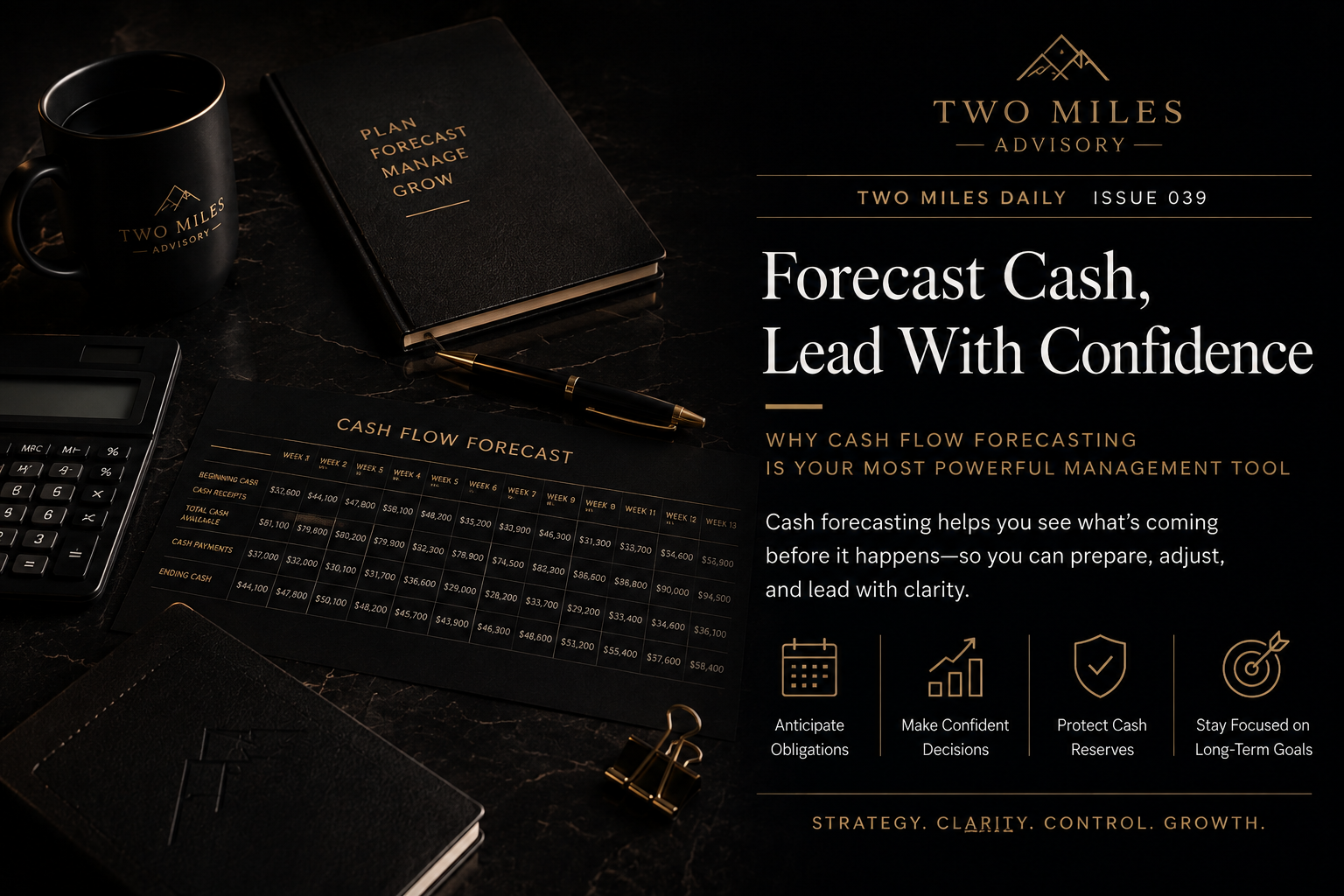
Two Miles Daily — Issue 039 Forecast Cash, Lead with Confidence
Knowing your bank balance isn't enough. A simple 13-week cash flow forecast can help you anticipate challenges, protect your cash reserves, and make confident business decisions before problems arise.
Executive Brief • August 2, 2026 • Two Miles Advisory
Many business owners review their financial statements every month.
Far fewer know exactly how much cash they'll have 30, 60, or 90 days from now.
That gap is where many financial problems begin.
A cash flow forecast isn't about predicting the future perfectly. It's about giving yourself enough visibility to make smart decisions before problems become emergencies.
Businesses rarely fail because they didn't know what happened last month.
They struggle because they didn't see next month coming.
Why Cash Flow Forecasting Matters
Profit tells you whether your business is making money.
Cash flow tells you whether your business can survive.
A profitable company can still run out of cash if customer payments arrive too slowly or large expenses come due before money is collected.
On the other hand, a business with modest profits but strong cash management often grows steadily without constant financial stress.
Knowing what's coming gives you options.
Waiting until your bank account is low limits them.
What Should Be Included?
A simple forecast doesn't need complicated software.
Start with your current bank balance and estimate the money expected over the next 13 weeks.
Include:
Expected Cash In
Customer payments
New sales
Loan proceeds
Tax refunds
Other expected income
Expected Cash Out
Payroll
Payroll taxes
Rent
Loan payments
Credit cards
Vendor payments
Insurance
Software subscriptions
Sales tax
Estimated income taxes
Owner distributions
Equipment purchases
Update it every week.
As new information comes in, your forecast becomes more accurate.
What a Forecast Helps You See
A good cash forecast allows you to identify issues while there is still time to respond.
You may discover:
Payroll will be tight in three weeks.
A large customer payment is running late.
Sales tax is due the same week as payroll.
An owner distribution should wait another month.
A large equipment purchase can safely move forward.
Instead of reacting under pressure, you're making decisions from a position of confidence.
Warning Signs
If your forecast consistently shows negative cash balances, don't ignore it.
Look for ways to improve cash flow:
Invoice customers immediately.
Follow up on overdue accounts.
Negotiate longer payment terms with vendors.
Delay non-essential purchases.
Reduce unnecessary subscriptions.
Build a cash reserve during strong months.
Small adjustments made early are much easier than emergency decisions later.
Cash Forecasting Is a Leadership Tool
Owners often think forecasting is something only large companies need.
The opposite is true.
Smaller businesses usually have less margin for error.
Knowing where your cash will be next month allows you to:
Hire with confidence.
Invest in growth.
Sleep better.
Avoid unnecessary borrowing.
Make better strategic decisions.
Forecasting transforms uncertainty into preparation.
CFO Insight
At Two Miles Advisory, we believe business owners deserve more than historical reports.
Your accounting should help you make your next decision—not simply explain your last one.
A cash flow forecast is one of the simplest tools that can dramatically improve decision-making, reduce stress, and strengthen your business.
You don't need to predict the future perfectly.
You simply need to be prepared for it.
The businesses that succeed aren't always the ones making the most money. They're the ones that know what's coming next.
Plan ahead.
Lead confidently.
Grow intentionally.
About Two Miles Daily
Two Miles Daily is a daily executive briefing from Two Miles Advisory, delivering practical insights on leadership, finance, operations, and business strategy for entrepreneurs and growing businesses.
Our mission is simple:
Help business owners make one better decision every day.
Think Like a CEO. Decide Like a CFO. Build Like an Owner.
Published by Two Miles Advisory

Two Miles Daily — Issue 038 Your Bank Balance Is Not Your Available Cash
A healthy bank balance does not always mean your business has money available to spend. Learn how to separate committed funds from truly available cash and avoid unexpected shortages.
Executive Brief • August 1, 2026 • Two Miles Advisory
A healthy bank balance can create a false sense of security.
You log in, see money in the account, and assume the business is doing well. You may decide it is safe to make a large purchase, take an owner distribution, hire someone, or pay down debt.
But not every dollar sitting in your bank account is truly available to spend.
Some of that money may already belong to someone—or something—else.
It may be needed for:
Payroll and payroll taxes
Sales tax collected from customers
Upcoming vendor payments
Credit card balances
Loan payments
Income tax estimates
Customer deposits tied to unfinished work
Insurance renewals
Equipment repairs
Other obligations that have not cleared the bank yet
That is why managing a business based only on the current bank balance can be dangerous.
Cash in the Bank Versus Cash Available
Imagine your business has $80,000 in its checking account.
At first glance, that may feel like a comfortable amount of cash. But you also know that the business has:
$24,000 of payroll and payroll taxes due
$18,000 of vendor bills coming due
$7,000 of sales tax collected but not yet remitted
$9,000 reserved for quarterly income taxes
$5,000 in upcoming loan and credit card payments
After accounting for those obligations, only $17,000 is truly uncommitted.
The bank says you have $80,000.
Your financial reality says you have $17,000 available for new decisions.
That is a significant difference.
Why Owners Get Caught Off Guard
Many cash shortages are not caused by an unprofitable business. They happen because the owner did not account for timing.
Revenue may have been deposited, but the related expenses have not yet been paid. Payroll taxes may have been withheld but not remitted. A customer may have paid a deposit for work that still needs to be completed.
The cash is visible, but the obligation is temporarily hidden.
This becomes especially risky when a business is growing. More sales often require more inventory, labor, subcontractors, shipping, equipment, or overhead before the company collects the next round of customer payments.
Growth can increase the amount of cash moving through the business while simultaneously reducing the amount of cash that is actually free to use.
Create Simple Cash Buckets
You do not necessarily need several bank accounts, although separate accounts can be helpful. You do need a way to identify what the money in the account is intended to cover.
A simple cash summary might include:
Operating cash
Money available for ordinary business expenses.
Payroll reserve
The next payroll, employer taxes, and employee withholdings.
Tax reserve
Sales tax, payroll tax, and estimated income tax obligations.
Committed payments
Vendor bills, debt payments, insurance, rent, and recurring expenses.
Customer deposits
Funds received for work or products that have not yet been delivered.
Emergency reserve
Cash set aside for unexpected costs or a temporary decline in revenue.
Once these amounts are identified, subtract them from the bank balance. The remainder gives you a much clearer picture of what the business can safely spend.
Look Forward, Not Just Backward
Financial statements tell you what has already happened. Cash forecasting helps you prepare for what is about to happen.
At least once a week, review:
The current bank balance
Expected customer collections
Payroll and tax deadlines
Bills due within the next few weeks
Debt and credit card payments
Large planned purchases
Any unusually slow-paying customers
A basic 8- to 13-week cash forecast can be one of the most valuable management tools in a growing business. It does not need to be perfect. Its purpose is to help you identify potential shortages early enough to respond.
You may decide to accelerate collections, postpone a purchase, adjust owner distributions, negotiate a vendor payment date, or arrange financing before the situation becomes urgent.
Be Careful With Owner Distributions
One of the easiest mistakes is taking money out of the business simply because cash is currently available.
Before making an owner distribution, ask:
Are all payroll and tax obligations covered?
Are upcoming vendor payments accounted for?
Does the business have enough cash for the next operating cycle?
Are there customer deposits that still need to fund future work?
Will the business still have an appropriate emergency reserve?
A distribution should come from truly available cash—not from money that is temporarily passing through the account.
CFO Insight
Your bank balance answers one question:
How much money is in the account today?
It does not automatically answer the more important question:
How much of that money can the business safely use?
Knowing the difference protects your company from unnecessary cash shortages, missed obligations, emergency borrowing, and decisions based on incomplete information.
Good cash management is not about being afraid to spend. It is about knowing exactly what you can afford before you commit.
About Two Miles Daily
Two Miles Daily is a daily executive briefing from Two Miles Advisory, delivering practical insights on leadership, finance, operations, and business strategy for entrepreneurs and growing businesses.
Our mission is simple:
Help business owners make one better decision every day.
Think Like a CEO. Decide Like a CFO. Build Like an Owner.
Published by Two Miles Advisory

ISSUE 037 • Cash Flow Is a Habit, Not a Coincidence
Healthy cash flow doesn't happen by accident. It's the result of consistent habits, disciplined decisions, and proactive management. Businesses that treat cash flow as a daily responsibility—not a monthly surprise—are far better positioned to grow through both opportunities and challenges.
Executive Brief • July 31, 2026 • Two Miles Advisory
Executive Perspective
Ask most business owners how their company is doing, and many will answer by talking about sales.
"We had our best month ever."
"Revenue is up."
"We're busier than we've ever been."
Those are encouraging signs.
But they don't answer one of the most important questions in business:
"How is your cash flow?"
Revenue tells you what you've earned.
Cash tells you what you can actually use.
The difference matters.
Cash Doesn't Manage Itself
Many owners assume that if sales continue to grow, cash will naturally follow.
Sometimes it does.
Often it doesn't.
Cash flow is created through hundreds of small decisions made consistently over time.
Sending invoices immediately.
Following up on overdue accounts.
Managing inventory carefully.
Negotiating favorable payment terms.
Avoiding unnecessary debt.
Monitoring expenses before they become habits.
None of these decisions are exciting.
But together, they determine whether your business has the flexibility to invest, hire, and grow.
Every Dollar Has a Job
Healthy businesses don't allow cash to sit unmanaged.
They intentionally decide where every dollar should go.
Some dollars build reserves.
Some reduce debt.
Some fund equipment.
Some create new opportunities.
Every dollar should support the future of the business.
When cash has a purpose, businesses become more resilient.
Good Habits Prevent Big Problems
Cash flow issues rarely appear overnight.
They're usually the result of small habits repeated for months.
Invoices sent a week late.
Customers allowed to pay whenever they choose.
Expenses approved without accountability.
Inventory purchased "just in case."
One decision doesn't create a crisis.
A hundred small decisions often do.
Fortunately, the opposite is also true.
Small positive habits create remarkable financial strength over time.
Cash Creates Freedom
Strong cash flow gives business owners something many people overlook:
Options.
The ability to hire.
To invest.
To survive unexpected challenges.
To negotiate from a position of strength.
To sleep better at night.
Businesses with healthy cash flow don't just survive uncertainty.
They're prepared for it.
Make Cash Management Routine
Don't wait until payroll is approaching.
Don't wait until the bank balance feels uncomfortable.
Review cash flow regularly.
Forecast upcoming needs.
Watch collection trends.
Ask better questions.
Strong businesses don't hope cash will be there.
They manage it intentionally.
Because cash flow isn't luck.
It's leadership.
CFO Insight
Strong cash flow isn't built through one big decision. It's built through hundreds of small, disciplined habits.
About Two Miles Daily
Two Miles Daily is a daily executive briefing from Two Miles Advisory, delivering practical insights on leadership, finance, operations, and business strategy for entrepreneurs and growing businesses.
Our mission is simple:
Help business owners make one better decision every day.
Think Like a CEO. Decide Like a CFO. Build Like an Owner.
Published by Two Miles Advisory

ISSUE 036 • Your Best Customers Deserve More Than Your Best Prospects
Many businesses spend enormous amounts of time chasing new customers while unintentionally neglecting the ones who already trust them. Long-term relationships are often your greatest competitive advantage—and your most profitable investment.
Executive Brief • July 30, 2026 • Two Miles Advisory
Executive Perspective
Most businesses are built around one question:
"How do we get more customers?"
It's a good question.
Without new customers, growth eventually slows.
But there's another question that often receives far less attention.
"How well are we taking care of the customers we already have?"
The answer to that question usually has a greater impact on long-term profitability than most owners realize.
Acquiring Customers Is Expensive
Winning a new customer requires time.
Marketing.
Networking.
Sales calls.
Proposals.
Follow-up.
Negotiation.
Sometimes months of effort.
When someone finally chooses your business, you've already made a significant investment.
That relationship is valuable.
Far too valuable to treat as ordinary.
Trust Is Built One Interaction at a Time
Your best customers rarely stay because you have the lowest price.
They stay because you've earned something far more valuable.
Their confidence.
Every phone call answered promptly.
Every deadline met.
Every problem solved professionally.
Every promise kept.
Trust compounds over time.
Just like investments.
And once it's established, it becomes one of the strongest competitive advantages a business can have.
Loyal Customers Become Your Best Sales Team
Satisfied customers don't just come back.
They recommend you.
They introduce you to colleagues.
They leave positive reviews.
They defend your reputation when others question it.
Those referrals often arrive with something advertising can never buy:
Trust before the first conversation.
That's why referrals typically close faster and remain customers longer.
Make Retention a Strategy
Ask yourself:
When was the last time you thanked your best customer?
Do you check in when you don't need something?
Do you know their long-term goals?
Have you looked for ways to create additional value?
Customer retention isn't passive.
It's intentional.
Relationships Build Businesses
Products can be copied.
Pricing can be matched.
Technology changes.
Markets evolve.
But genuine relationships are difficult to replicate.
The businesses that thrive over decades understand that every customer is more than a transaction.
They're a relationship worth protecting.
Growth will always matter.
But lasting businesses are built by serving today's customers so well that they never consider going elsewhere.
CFO Insight
Don't become so focused on finding your next customer that you forget to take care of your best one.
About Two Miles Daily
Two Miles Daily is a daily executive briefing from Two Miles Advisory, delivering practical insights on leadership, finance, operations, and business strategy for entrepreneurs and growing businesses.
Our mission is simple:
Help business owners make one better decision every day.
Think Like a CEO. Decide Like a CFO. Build Like an Owner.
Published by Two Miles Advisory

ISSUE 035 • If You Can't Measure It, You Can't Improve It
Successful businesses don't rely on instinct alone—they rely on meaningful data. Tracking the right Key Performance Indicators (KPIs) allows you to identify trends, solve problems early, and make confident decisions that move your business forward.
Executive Brief • July 29, 2026 • Two Miles Advisory
Executive Perspective
Every business owner tracks something.
Sales.
Cash in the bank.
The number of new customers.
But the businesses that consistently outperform their competitors measure much more than revenue.
They measure the activities that drive revenue.
These measurements are called Key Performance Indicators, or KPIs.
A KPI is simply a number that tells you whether your business is moving in the right direction.
The right KPIs help you spot problems before they become expensive.
They also reveal opportunities long before they're obvious to everyone else.
Revenue Is a Lagging Indicator
Most owners celebrate increased sales.
And they should.
But revenue tells you what has already happened.
It doesn't explain why it happened—or whether it will continue.
For example, imagine sales increase by 20%.
That sounds like great news.
But what if:
Gross margin declined?
Customer acquisition costs doubled?
Cash collections slowed?
Employee overtime increased significantly?
Revenue increased.
Yet profitability may have actually declined.
Looking at one number rarely tells the whole story.
Measure What Drives Success
Every business has a handful of numbers that matter more than the rest.
Some of the most valuable KPIs include:
Gross profit margin
Cash flow
Accounts receivable aging
Average collection period
Customer retention
Project profitability
Inventory turnover
Employee utilization
Net profit percentage
You don't need dozens of reports.
You need a few meaningful numbers reviewed consistently.
Trends Matter More Than Snapshots
One month's results rarely tell the whole story.
A trend tells a story.
If your gross margin has slowly declined over six months, there's probably a reason.
If customer retention has steadily improved, something you're doing is working.
If accounts receivable continue growing each month, cash flow problems may be right around the corner.
Business leaders should spend less time reacting to individual months and more time understanding long-term trends.
Turn Data Into Decisions
Collecting data isn't the goal.
Making better decisions is.
The best businesses don't review reports simply to satisfy curiosity.
They review them to answer questions like:
Where should we invest?
What should we improve?
Which customers are most profitable?
Which projects deserve more attention?
Where are we losing money?
Numbers should drive conversations.
Conversations should drive action.
Action drives results.
Start With Three KPIs
If you aren't tracking KPIs today, don't start with twenty.
Start with three.
Choose three numbers that directly impact your business.
Review them every month.
Discuss what changed.
Ask why.
Then make one improvement before next month.
Over time, small improvements become significant competitive advantages.
The businesses that improve the fastest are rarely guessing.
They're measuring.
CFO Insight
The businesses that improve the fastest aren't the ones with the best instincts—they're the ones measuring what matters.
About Two Miles Daily
Two Miles Daily is a daily executive briefing from Two Miles Advisory, delivering practical insights on leadership, finance, operations, and business strategy for entrepreneurs and growing businesses.
Our mission is simple:
Help business owners make one better decision every day.
Think Like a CEO. Decide Like a CFO. Build Like an Owner.
Published by Two Miles Advisory

ISSUE 034 • Growth Doesn’t Solve Operational Problems
Many business owners believe that increasing sales will solve their biggest challenges. In reality, growth often magnifies operational weaknesses. Before scaling your business, make sure your processes, systems, and financial controls are ready to grow with you.
Executive Brief • July 28, 2026 • Two Miles Advisory
Executive Perspective
One of the biggest misconceptions in business is that growth solves problems.
More sales.
More customers.
More employees.
More revenue.
It sounds like the perfect solution.
But in reality, growth rarely fixes operational problems.
It usually exposes them.
In many cases, it makes them significantly worse.
Revenue Is an Amplifier
Imagine your business as a house with a small leak in the roof.
During a light rain, the damage seems manageable.
Now imagine a major storm.
The roof doesn't suddenly become stronger because there's more rain.
The weakness simply becomes more obvious.
Business works the same way.
When revenue increases, every existing process is put under greater pressure.
If your invoicing process is inefficient today, it will become overwhelming with twice the number of customers.
If your inventory management is inconsistent today, more orders will create even more shortages and errors.
If communication between departments is poor, additional employees often create more confusion rather than greater efficiency.
Growth amplifies what already exists.
Strong Businesses Scale Their Systems First
Successful companies understand that growth should be supported—not chased.
Before adding more customers, they ask questions like:
Can our current systems handle double the workload?
Are our financial reports timely and accurate?
Can we collect customer payments efficiently?
Do employees understand their responsibilities?
Are our processes documented and repeatable?
These questions may not feel exciting.
But they create the foundation for sustainable growth.
Operational Excellence Creates Financial Strength
Every efficient process eventually appears in your financial statements.
Invoices go out faster.
Customers pay sooner.
Errors decrease.
Labor becomes more productive.
Projects finish on schedule.
Profit margins improve.
Cash flow becomes more predictable.
Strong operations create strong financial performance.
The opposite is also true.
Weak operations quietly consume profits through wasted time, unnecessary expenses, customer dissatisfaction, and avoidable mistakes.
Growth Without Control Creates Risk
Many businesses celebrate rapid growth without recognizing the risks that accompany it.
Hiring too quickly.
Accepting projects without adequate planning.
Expanding into new markets without sufficient cash reserves.
Growing revenue while neglecting profitability.
These decisions can create the appearance of success while increasing financial pressure behind the scenes.
Growth should strengthen your business—not strain it.
Build Before You Scale
One of the best investments any business owner can make is improving the systems that support future growth.
Document your processes.
Measure key performance indicators.
Review your financial statements regularly.
Improve communication.
Strengthen internal controls.
These investments rarely make headlines.
But they create businesses that can grow confidently for years to come.
The companies that scale successfully are rarely the ones growing the fastest.
They're the ones with the strongest foundation.
CFO Insight
Growth magnifies both strengths and weaknesses. Build strong systems before you build a bigger business.
About Two Miles Daily
Two Miles Daily is a daily executive briefing from Two Miles Advisory, delivering practical insights on leadership, finance, operations, and business strategy for entrepreneurs and growing businesses.
Our mission is simple:
Help business owners make one better decision every day.
Think Like a CEO. Decide Like a CFO. Build Like an Owner.
Published by Two Miles Advisory

ISSUE 033 • The Cost of Waiting
Every business decision has a cost, including the decision to wait. Delaying a pricing change, difficult conversation, hiring decision, or overdue process improvement may feel safer in the moment, but waiting often allows small problems to become larger and more expensive.
Executive Brief • July 27, 2026 • Two Miles Advisory
Executive Perspective
One of the most expensive decisions in business is the decision to wait.
It rarely feels costly in the moment.
In fact, waiting often feels safe.
"We'll address it next month."
"Let's see how things look after the next quarter."
"We'll revisit it when business slows down."
Unfortunately, problems rarely become smaller simply because we postpone them.
Small Problems Grow Quietly
Most business challenges begin as minor inconveniences.
A customer starts paying a little slower.
Gross margins decline by a few percentage points.
Inventory slowly accumulates.
Operating expenses increase one subscription at a time.
An employee struggles with performance.
None of these issues seem urgent on their own.
But together, they can quietly reshape the financial health of an entire business.
The longer they're ignored, the more expensive they become.
Opportunity Has an Expiration Date
Waiting doesn't just increase costs.
It also delays opportunity.
Perhaps you've considered:
Hiring someone who would free your time.
Investing in software that improves efficiency.
Raising prices to reflect increased costs.
Creating processes that reduce mistakes.
Expanding into a profitable market.
Every month you delay, you're also delaying the benefits those decisions could have generated.
Sometimes the greatest cost isn't what you lose.
It's what you never gain.
Perfect Information Doesn't Exist
Many leaders delay decisions because they want more certainty.
More information.
More confidence.
The reality is that no business owner ever has complete information.
Markets change.
Customers change.
Employees change.
Conditions change.
Successful leaders don't wait for perfect certainty.
They make informed decisions using the best information available, then adjust as they learn more.
Progress almost always beats perfection.
The Financial Cost of Delay
As a financial controller, I've seen businesses spend months discussing problems that could have been solved in a single afternoon.
An overdue customer becomes an uncollectible account.
An outdated pricing model quietly reduces profitability.
A hiring decision delayed too long causes burnout for the entire team.
Every delay has a financial impact.
Sometimes it's visible.
Often it isn't.
Build a Habit of Decisive Leadership
This doesn't mean making reckless decisions.
It means developing a habit of addressing important issues while they're still manageable.
Ask yourself:
What decision have I been postponing?
Why am I waiting?
What is waiting actually costing me?
You may discover that taking action today is far less expensive than delaying another month.
Business rewards thoughtful action—not endless hesitation.
CFO Insight
The cost of waiting is often greater than the cost of deciding. Progress begins when action replaces hesitation.
About Two Miles Daily
Two Miles Daily is a daily executive briefing from Two Miles Advisory, delivering practical insights on leadership, finance, operations, and business strategy for entrepreneurs and growing businesses.
Our mission is simple:
Help business owners make one better decision every day.
Think Like a CEO. Decide Like a CFO. Build Like an Owner.
Published by Two Miles Advisory