
Two Miles Daily, Issue 059: Before You Pay a Sub, Get the W-9 and the COI
It's October, a good week to talk about something that causes stress in January.
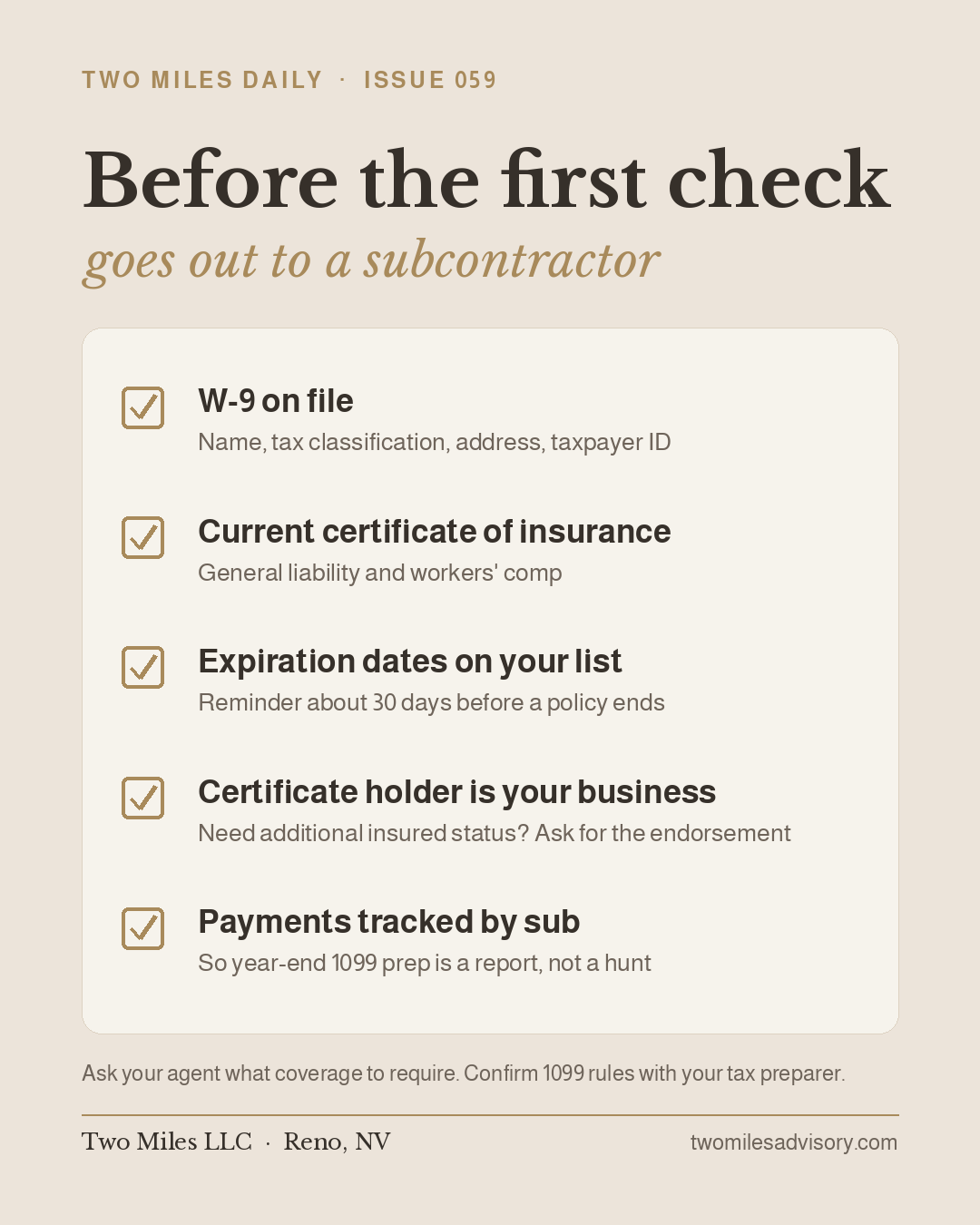
If you hire subcontractors, two pieces of paper should be in your file before the first check goes out: a W-9 and a certificate of insurance (COI).
The W-9 gives you the sub's name, federal tax classification (sole proprietor, LLC, corporation), address and taxpayer ID number. That's what you need for 1099s after year-end. There's a money reason, too: if a payee doesn't give you a taxpayer ID, you may be required to withhold 24% of reportable payments (backup withholding).
The COI is the insurer's summary of what the sub carries, typically general liability and workers' compensation. It's a snapshot, not a guarantee.
Workers' comp matters most. In Nevada, a licensed contractor can be treated as the employer of a sub's workers for workers' comp purposes (see NRS 616A.210 and 616B.603). If a sub's employee is hurt and the sub has no coverage, the cost can land on you. Ask for proof of workers' comp, not just general liability, and check with your insurance agent or an attorney about what applies to you. This isn't legal advice.
A simple system:
No paperwork, no payment. A W-9 and a current COI come before the first payment. Put it in your sub agreement so it isn't personal. A contract clause helps, but it doesn't replace checking the coverage.
Keep one list. Sub name, W-9 date, COI date, expiration date, total paid. A spreadsheet is fine.
Watch expiration dates. Set a reminder 30 days ahead and ask for the renewed certificate.
Check the details. Make sure your business is the certificate holder. If you need to be an additional insured, ask for the endorsement, not just the certificate.
Track payments by sub, so year-end isn't a hunt.
A quick note on 1099s: for payments made in 2026, the federal reporting threshold for Form 1099-NEC is $2,000 (it was $600 for payments made before 2026). Not every payment needs a 1099. Payments to corporations (including LLCs taxed as corporations) generally don't, with exceptions such as attorney fees and certain other payments. Credit card and payment app payments are reported by the card company or app instead. Forms for 2026 payments are due Monday, Feb 1, 2027. Check the current IRS instructions or ask your tax preparer.
Hypothetical: a framing company has four subs this year. Three sent W-9s on day one. The fourth, a drywall sub, never did, and was paid $9,000. In January, that's the one that holds everything up.
If you'd like help building a sub tracking list, or getting your 1099 information organized before year-end, send me a message through the Contact page.
— Rachel, Two Miles LLC