
Two Miles Daily, Issue 058: Which Jobs Actually Made You Money?
Most contractors I talk to can tell me roughly what they billed this year. Fewer can tell me which jobs made money and which ones just kept the crew busy.
That's what job costing answers. Instead of putting every cost into one big pile, you track income and costs by job.
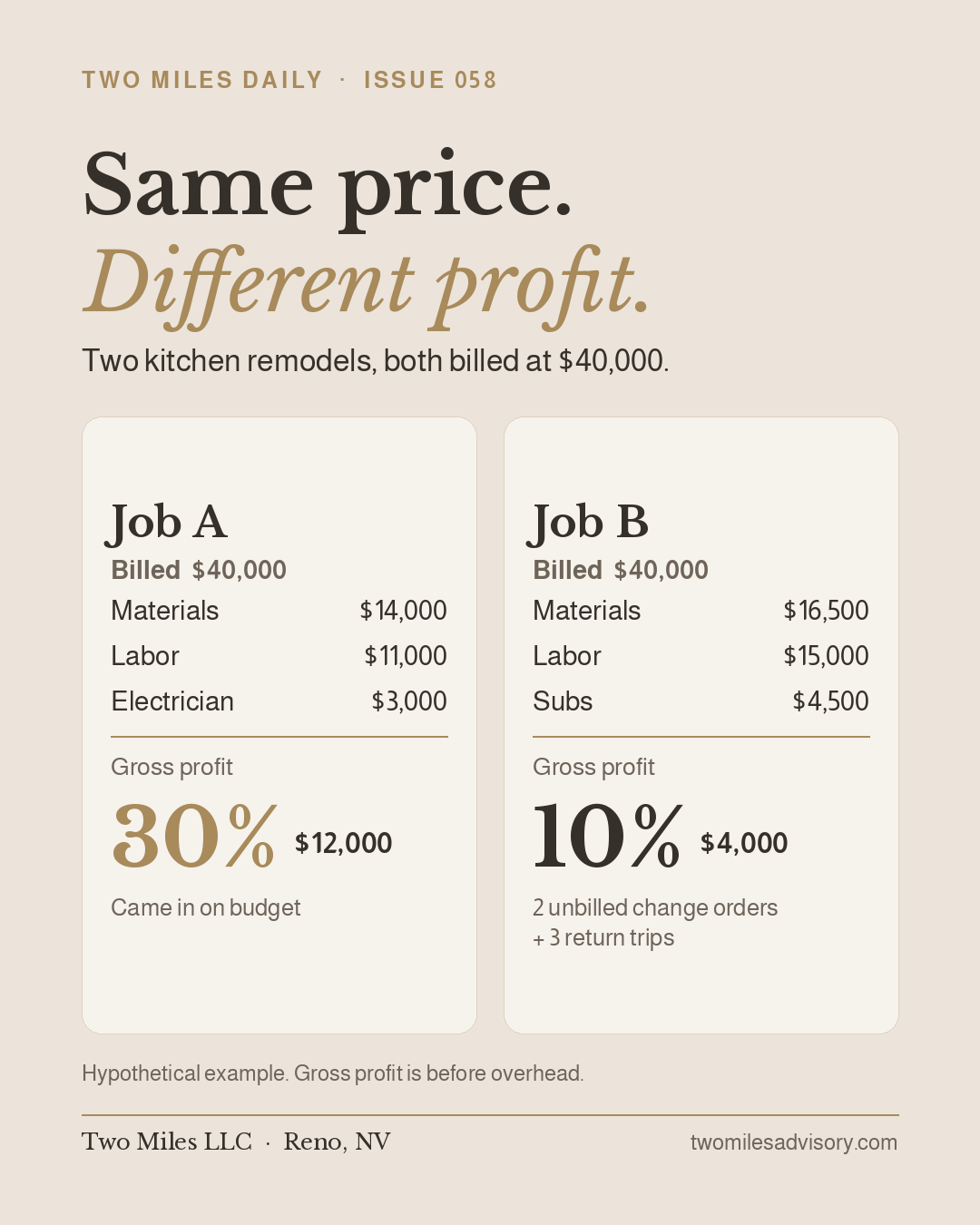
Here's a hypothetical. A remodeler finishes two kitchen jobs in the same month, each billed at $40,000. On the monthly P&L, they blend together. But separate the costs and the story changes:
Job A: $14,000 materials, $11,000 labor, $3,000 electrician. Came in on budget. Gross profit: $12,000 (30%).
Job B: $16,500 materials (two change orders that never got billed), $15,000 labor (late cabinet delivery, crew came back three times), $4,500 subs. Gross profit: $4,000 (10%).
(Gross profit here means what's left after a job's direct costs, before overhead like insurance, your office and your own pay.)
Same revenue, very different outcome. If you only look at the monthly total, you'd never know Job B was the problem, or that you might be bidding the next one exactly the same way.
You don't need fancy software to start. Here's what I'd set up first:
Give every job a name or number and use it everywhere: estimates, invoices, supply house receipts, timesheets.
Tag costs to the job when they happen. In QuickBooks Online, project tracking needs the Plus or Advanced plan. If you have one of those, assign a project to each bill, expense and timesheet. On a lower plan, put the job number on every transaction and keep a simple spreadsheet. A receipt with no job on it is a cost you'll be guessing about later.
Track labor hours by job, not just total payroll. Labor is often where the surprises hide.
Bill change orders as they happen. An unbilled change order is one of the quietest ways a job's margin disappears.
Look back at finished jobs once a month. Estimate vs. actual: where did you miss, and why?
It doesn't have to be perfect on day one. Rough job costing still beats a guess, and after a few months you start seeing patterns: the type of job you keep underpricing, the customer who always adds scope, the sub who's worth every penny.
Then your next bid is based on what jobs actually cost you, not what you hoped they'd cost.
If you'd like help setting up job costing in your books, or looking back at your last few jobs to see what they really made, send me a message through the Contact page and tell me what kind of work you do.
— Rachel, Two Miles LLC